Archive for the Tag 'R&D'

How Xerox Monetizes Non-Core Innovation

Point:
Monetize non-core innovation rather than pruning it.

Story:
Ursula Burns, CEO of Xerox, discussed innovation at her company in an interview at the World Innovation Forum June 9, 2010. She described initiatives to improve the return on innovation at Xerox’s  research centers such as PARC (Palo Alto Research Center). PARC’s ground-breaking inventions like the graphical user interface, ethernet, and postscript as inventions  had a large impact on the world but didn’t contribute enough to Xerox’s bottom line.  Let’s look at why that happened and what Xerox is doing now.

Unpredictability lies at the core of the innovation process.  Not only do innovators not know if an early-stage innovation will succeed or fail, they also can’t know all the possible applications or value latent in that innovation.  Thus, it’s far too easy for an exciting innovation to stray outside the bounds of the company’s core competence.

At some level, reaping the greatest value from a research organization means allowing researchers the freedom to explore.  Burns noted that innovators love working on interesting projects — it’s hard to stop them from doing it.  Rather than fetter its folk, Xerox found three ways to give them freedom while still reaping the value of innovations that fall outside the company’s core.

First, Xerox expanded its definition of what is core to the company.  Previously, Xerox defined itself as a copier company, looking for innovations in how to “reproduce images on paper.” That narrow definition meant that many of the early PARC inventions were not pursued. Since then, Xerox expanded to document management and is moving toward being a more general office information process company.  Rather than fear the paperless office, Xerox wants to help customers implement the paperless office.  Xerox’s recent acquisition of ACS positions Xerox in business process outsourcing — managing the non-paperless back office functions of customers and clients.  The expanding vision of Xerox brings more innovations within the scope of the company’s core. For example, the company now has a use for its smart document innovations that can automate some of the labor-intensive discovery process in legal proceedings.

Second, rather than discarding innovations that don’t fit inside the company, Xerox now looks for partners or buyers for whom the innovation does provide value.  For example, some of Xerox’s innovations in precision printing can apply to the low-cost manufacturing of solar panels.  Xerox isn’t going to become a solar panel manufacturer — that’s too far outside its core. But rather than dismissing the innovation, Xerox partnered with a West Coast firm to incubate a new company that can leverage the value of those innovations.

Third, outside companies can now hire PARC and its portfolio of specialists to tackle tough R&D problems.  CEO Burns said that most PARC’s activities remain focused on Xerox, but the option to sell non-core innovations lets the company maintain the innovative culture of PARC while monetizing its researchers’ outputs.  In short, Xerox is expanding how it leverages the fruits of innovation rather than pruning the innovation funnel.

Action

  • When evaluating innovation projects, don’t immediately rule out ideas outside the company’s current strategies, customers, or core
  • Instead, also ask if an innovation might be more valuable to a non-competing outsider
  • Find complementary partners who can license or buy non-core innovations or innovation expertise to reap the greatest total value from the innovation process.
  • Allow innovators enough freedom to enable breakthroughs.
  • Expand or reenvision the core of the company to leverage innovation.
1 Comment »Case study, How-to, Innovation

How Boston Scientific Accelerates Innovation

Point: Capture, share and reuse knowledge to make R&D engineers more productive

Story:

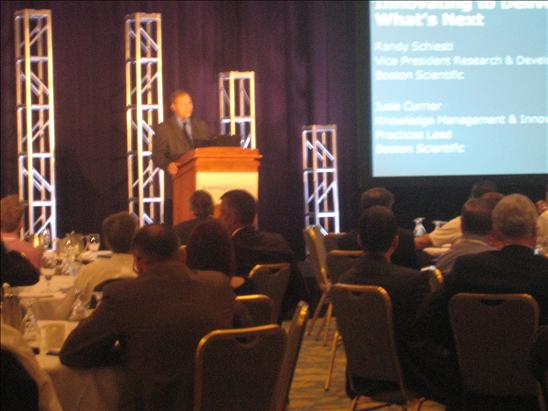
At Power to Innovate 2009, Boston Scientific’s Randy Schiestl (VP of R&D) and Jude Currier (Cardiovascular Knowledge Management & Innovation Practices Lead) described how Boston Scientific is redesigning its innovation processes. The goal: to accelerate time to market, increase the productivity of innovators, and reduce costs and risks.

Boston Scientific is an $8 billion company committed to delivering innovative medical technologies that improve the quality of patient care as well as healthcare productivity. The company has a broad portfolio of 13,000 products. The new products in its pipeline include drug coated stents, bare metal stents, catheter and bio-absorbable technology.

In the past, Boston Scientific drove innovation from business strategy to technology development to product development. In this staged approach, engineers created technology-driven products that were then shown to business units and customers at the prototype stage. The trouble with this process was that the later groups often found gaps or risks in the proposed product late in the product development process. As a result, the company had to spend more money than expected putting out fires while trying to hold to a launch schedule.  Boston Scientific decided to change its innovation process to bring more knowledge and resources into the earlier stages of innovation.

As part of the new innovation process, Boston Scientific began bringing in key “voices” into the innovation process earlier. By getting these voices — the voice of the customer, the voice of the business unit, and the voice of regulatory bodies — earlier, the company uncovered its knowledge gaps and risks much sooner. The second part of Boston Scientific’s innovation process redesign gave employees access and pointers to relevant information, whether that information resided in a document or in the tacit knowledge of an expert. The goal here was to reduce the amount of time engineers spend looking for knowledge. Schiestl said engineers spend 30% of their time looking for relavant knowledge. To improve upon that, Boston Scientific used Goldfire (innovation software from Invention Machine) to capture, share and reuse knowledge.  Goldfire’s semantic technology automatically categorizes concepts can and ties relevant intelligence to specific innovation initiatives. For example, engineers used Goldfire to identify past research and then validate whether that research could be repurposed. The result: Boston Scientific engineers who used Goldfire spent only 10 percent of their time researching intelligence, compared to 20-30 percent by non-Goldfire users.

Boston Scientific’s new innovation process illustrates what Mark Atkins, CEO of Invention Machine, called an innovation intelligence ecosystem.  This ecosystem represents the aggregate of information, communities, and processes that collectively contribute to innovation. Here’s how it works: using innovation software like Invention Machine’s Goldfire, companies capture and reuse information and intellectual capital created by employees as well as by external sources. Goldfire further enables collaboration by accurately reconstructing a user’s past thinking and research process, making it visible and explicit to other users. Employees avoid reinventing or duplicating research already done, thus saving time and improving innovation productivity.

Boston Scientific shared two examples of its success using Goldfire and the company’s new innovation processes. First, the company improved the design of cardiac stents to reduce a patient’s injury-response to the device. By combining knowledge from across the innovation ecosystem, the company mapped key clinical knowledge about heart disease and how different heart artery conditions affect the patient outcomes with different stent designs.

In the second example, Boston Scientific used Goldfire to solve a technical problem in manufacturing that was reducing product yields.  Using Goldfire, Boston Scientific found that previously undocumented thermocapillary effects were leading to clogged spray nozzles. By understanding the physics of the cause, Boston Scientific was able to make a simple change to the manufacturing line to eliminate the clogging and thereby improve yields.

Action:

  • Uncover all the “voices” that have a say in the success of innovations (the voice of the customer, voice of technologists, voice of manufacturing, voice of regulatory compliance, etc.).  Connect key people and communities in a more collaborative, sharing-oriented environment
  • Identify, organize, and access information (internal and external) needed by these communities to do their innovation-related work.
  • Develop knowledge and innovation processes that find and resolve knowledge gaps or risks early in the innovation process.

No Comments »Case study, How-to, Innovation, New Product Development, Productivity, R&D, Software tool, Strategy

Kraft: the “$40 Billion Start-Up” Spurs Innovation

Point: Open innovation can accelerate new product development

Story: When Irene Rosenfeld took over as CEO of Kraft, she saw an anemic innovation pipeline. IrenePhotoThe company had 2000 corporate R&D staff — scientists, engineers and chemists — but new products weren’t flowing rapidly enough.   Her solution to encourage innovation?  To get everyone to “Think of Kraft as a $40 billion start-up,” she said at the World Business Forum on October 7, 2009.  One way to emulate start-up thinking is to be open to new ideas from anywhere and quickly turn them into something valuable. Kraft reached out beyond its corporate R&D to enlist the help of employees across the whole company, as well as suppliers and partners, to spur innovation.

For example, Kraft runs an online “Innovate with Kraft” program whereby anyone can submit product ideas.  Although skeptics call such programs gimmicks or fads, Rosenfeld maintains that they’re not gimmicks if the programs and the ideas generated from them are being used.

Kraft’s recent new product introduction, Bagel-fuls (frozen bagels pre-filled with Philadelphia brand Cream Cheese), for example, came from an unsolicited idea from a third-generation bagel maker in a niche market. The idea was a win-win for both companies: it solved some technical challenges that Kraft had faced in delivering a bagel and cheese combo, and it expanded the bagel-makers product beyond his niche.

Rosenfeld also mentioned the value of platform-based innovation (ideas that span multiple brands and geographies) in the innovation process.  Now, “Our innovation pipeline is quite full,” Rosenfeld remarked, with new products coming out in four core areas: Snacking, Quick Meals, Premium and Health & Wellness.

Action

  • Look for ideas in the corners: reach out to employees and suppliers, especially niche people, to uncover obscure ideas that merit more widespread use
  • Celebrate the use of submitted ideas to show the value of participation in innovation submission programs.

For more information:
Irene Rosenfeld at the World Business Forum on Oct 6, 2009 #wbf09

http://www.usatoday.com/money/companies/management/profile/2008-12-10-ceo-forum-kraft-irene-rosenfeld_N.htm

Staggs, Sandy. Foster Innovation at Kraft Foods, Oct 27, 2008.

New York Times, Sept. 9, 2009

No Comments »CEO, Case study, Innovation, Strategy

Where in the World to Invest During a Downturn

Point: Government policy affects foreign investment and innovation. Brazil is poised to do well.

Story: During a recent HSM webinar, Jeffrey Sachs (leading international economic advisor, sachs-largeColumbia University professor and author of New York Times bestsellers Common Wealth and The End of Poverty), was asked about the near-term prospects for Latin American countries and which countries he thought would do best. Sachs’ answer: Brazil is poised to do best.

For the last 15 years, Brazil has been investing heavily in education. In particular, Brazil made high school available to all citizens and invested in higher education, science and technology. The result is not only a more educated workforce but also a narrowing of the gap between rich and poor and between ethnically divided segments of Brazilian society. In contrast, countries with deep ethnic and racial inequities aren’t unified societies, which leads to mediocre economic performance. Brazil plans to invest $22 billion in science and technology innovation in 2010 and seeks corporations to join in additional investments in the country.

Sachs’ optimism about Brazil echos IBM’s sentiments. IBM is one of the companies investing in Brazil. CEO Sam Palmisano recently met with Brazilian President Luiz Inacio Lula Da Silva to discuss the creation of a “collaboratory” in Brazil. IBM’s  collaboratories match IBM researchers with local experts from governments, universities and companies. IBM’s Palmisano praised Brazil’s strategy: “Investments in innovation are critical, especially in a downturn. They can help Brazil and other countries, including the US, realize an economic expansion.”  Among the BRIC countries (Brazil, Russia, India, and China), Brazil is seeing the highest growth in business partners that IBM works with, averaging 150% year over year, according to Claudia Fan Munce, managing director of IBM Venture Capital Group.

Action:
* Consider the benefits of locating R&D labs to another country, such as gaining  opportunities to see the challenges and solutions  not visible from a US-centric perspective.
* When evaluating countries for investment potential, consider their economic policies (business environment, trade policy, investment policy, infrastructure) as well as any cultural barriers (ethnic, religious, gender inequalities) that may be a barrier to integrating the best talent and to fostering economic growth

Sources:

Jeffrey Sachs webinar: Economics for a Crowded Planet
“Big Blue’s Global Lab,” Business Week September 7, 2009
“IBM Bets on Brazilian Innovation” Business Week August 17, 2009
Jeffrey Sachs, Common Wealth: Economics for a Crowded Planet
Jeffrey Sachs, The End of Poverty: Economic Possibilities for Our Time

If you’d like to ask Jeffrey Sachs your own questions, you’ll have the opportunity at the World Business Forum in New York City October 6-7, 2009.

2 Comments »Capital, Growth, Innovation, Opportunity, R&D, Strategy

Cirque Du Soleil’s Visible and Invisible Innovation

Point: Behind-the-scenes innovation makes visible innovation shine

Story: I saw the premiere of KOOZA in Denver last week. Actually, it was my second time seeing KOOZA (the first was in Boston), and it was even better the second time.wheelofdeath1_th

The first time, I was mesmerized by the overt innovations in the show, like the “Wheel of Death.” Imagine two connected hamster-wheels, each of which spin while both together revolve vertically as well. Suspended high above the stage, the performers run, dive and somersault inside the wheels. And just when it looks like the act couldn’t get any more thrilling, the performers switch to running on the outside of the wheel.

contorsion1_thMy second time at KOOZA, I sat in the second row, so I had a closer look at the costumes. Even from the very last row (where I sat the first time), I remember the dazzling shine of the juggler’s suit. The second time, I had a chance to see the intricacy of all the costumes, which led me to wonder about the R&D that must go into them. The costumes hug tight body lines yet flex with all the contortions the performers make.

How does Cirque Du Soleil create these amazing costumes? First, Cirque hires talent: specialists in textile design, lace-making, shoemaking, wig-making, patternmaking, costume-making and millinery all work together to combine their knowledge.

Second, they actively seek out new materials which can be used. A “technological watch team” tracks global advances in adhesives, batteries and miniature lights to see how they could be incorporated into costumes. The team looks beyond boundaries of standard textiles to encompass fields such as avionics, plumbing, water sports and even dentistry for components that achieve the imagined task.

Third, the artisans of Cirque Du Soleil’s Costume workshop custom-make all the costumes, dyeing the colors in-house or painting costumes directly. They mold each individual hat on a plaster model of the artist’s head for a perfect fit. They consider comfort during these very athletic shows: the wig-making team, for example, builds wigs one hair at a time to achieve optimal ventilation. The attention to detail is staggering: the Bungee costumes used in Cirque’s Mystre each have over 2,000 hand-glued sequins. The juggler’s suit in KOOZA consists entirely of mirrored squares, like a disco ball.

Whether visible or hidden, Cirque du Soleil innovations shine.

Action:
* Hire specialists in multiple related disciplines to work as a creative team
* Explore beyond the expected. Cirque’s costume team doesn’t just use fabrics but expands into composite materials such as silicone, latex, plastics, foams and urethane
* Let team members be hands-on to devise ways to make an innovation work.

Further information:

If you’re in Denver, take advantage of seeing KOOZA yourself. It plays through Sept 27, with tickets available here. The show then moves to Santa Monica, CA in October and Irvine, CA in January. Info on future cities is here.

2 Comments »Case study, How-to, Innovation, New Product Development

High-Value Innovation: Innovating the Management of Innovation

Point: Inventing new management techniques offers high-leverage payback

Story: What’s more valuable than a new product or service innovation?  An innovation in a management technique, said business strategy expert Gary Hamel at the Spigit Innovation Summit last week. Innovations in management techniques have far-reaching impact.gary-hamel-photo

Consider Thomas Edison. He’s credited with 1093 patents, but one underlying invention is what made such a multitude of patents possible: the invention of the corporate R&D lab. Edison was the first to bring management discipline to research & development to enable a more powerful method of invention than the lone inventor of the past. Edison’s 1093 patents had less to do with technological genius and more to do with management genius: creating and managing an R&D lab that could efficiently and effectively crank out new inventions.

So, what steps can you take to innovate the management of innovation? Management is the effective control of resources to execute tasks that achieve goals. What then, does effective management of innovation look like Gary talked about the need for a combination of freedom and discipline: the freedom to come up with ideas but also the discipline to find the best ideas, refine them, and channel them into something that creates value for the firm. He posed it as a paradox, which is always a clue to generative potential.

As you think about improving the management of innovation, think about the recent inventions that you can draw on. For example, in my previous post, I wrote about how social media tools support innovation processes. These tools let you invite ideas from across the whole organization and provide a way to refine, track and vote on those ideas. Other advancements, like open sourcing and open innovation (see earlier post), help you tap into almost-free resources. Furthermore, widespread adoption of smartphones changes the fundamental equation of management in terms of reach and timeliness. All these technologies support new approaches to management, especially the management of innovation.

Action

  • Take a step back from inventing and innovation to think about how to improve the management of innovation
  • Ask: how can we generate new ideas more effectively with available resources? (freedom)
  • Ask: how can we develop and validate new ideas more effectively with available resources? (discipline)
  • Create coherent processes that balance resources between freedom and discipline

Further information:

Gary Hamel’s book, The Future of Management and his blog

I enjoyed hearing Gary speak and having the opportunity to ask him questions. If you’d like to do the same, consider joining me at the World Business Forum October 6-7, 2009 in New York City. Gary will be one of the speakers, along with former president Bill Clinton, Jack Welch, George Lucas, Paul Krugman and others. You can see the full agenda here.

No Comments »How-to, Innovation, Productivity, Strategy

Innovation Investment Strategy

Point: Organizing innovation investments into broad themes focuses energy and enables collaboration

Story: Until 2008, Hewlett-Packard Company (HP) Labs ran hundreds of research projects. Then new HP Labs’ director Prith Banerjee reduced the total number of projects and organized research into eight cross-cutting themes: Analytics, Cloud, Content transformation, Digital commercial print, Immersive interaction, Information management, Intelligent infrastructure and Sustainability. They then invited universities to submit research proposals within these core themes. In 2008, HP selected 45 projects at 35 institutions to receive HP Labs Innovation Awards. Winners in 2009 will be announced on March 16.

Similarly, Boulder venture capital firm Foundry Group invests in five themes: Human Computer Interaction, Implicit Web, Email, Glue, and Digital Life. The commonality among these five themes, besides the tie to software/internet/IT, is that the themes are horizontal rather than vertical. The themes cut across industries, just as HP’s the areas do. The Foundry Group’s goal is to identify underlying technology protocols and standards that have the potential to win big. When evaluating whether to invest in a new company, “our first question is, does it fit our investment themes?” said managing director Brad Feld. “We focus on broad horizontal themes where we can create market-leading companies.” For example, the Foundry Group invests in Lijit Networks, Inc. because Lijit’s search infrastructure services apply to any online publisher and because the search methodology uses people, their content, and their network connections to produce search results with unprecedented relevance.

Both HP and Foundry Group seek and invest in “big ideas” that have the potential to transform the marketplace. Investing horizontally means looking at transformational ideas that can lead to opportunities in many industries. For high-risk research and venture investments, choosing horizontal areas is a better risk management strategy for three reasons. First, it makes success less dependent on adoption of the idea within a given industry. Second, you avoid running into a major stumbling block, such as regulation or a big competitor, that could derail your success in a single industry. Third, it helps create agility by creating core innovations that can be adapted to a range of verticals, as needed. A horizontal approach lets you have more “irons in the fire” without being scattered. The grouping gives you a diversity of opportunity without the burden of a scattered approach.

Action:
* Aggregate and focus your R&D or project investment efforts into horizontal thematic areas
* Become an expert in those themes to seek out and nurture the big ideas
* Look for opportunities that cut across industries
* Avoid the temptation to be pulled in different directions that would dilute expertise or investment

For more information: HP Labs reports on its restructuring and open initiatives by Dean Takahashi

HP Labs’ eight theme areas

Foundry Group Theme Investing by Brad Feld

Silicon Flatirons Interview Series

No Comments »How-to, Innovation, Strategy